SIP vs Lumpsum: Which Is Better for Indian Investors?
A plain explanation of SIP and lumpsum investing, how returns are calculated, and how to compare them with a calculator.
By DocConvertPRO Editorial Team3 min read
SIP vs Lumpsum: Which Is Better?
Mutual funds in India can be bought two ways: by investing a fixed amount every month (SIP, Systematic Investment Plan) or by investing a large amount at once (lumpsum). Neither is always better. This guide explains how each works so you can decide with open eyes.
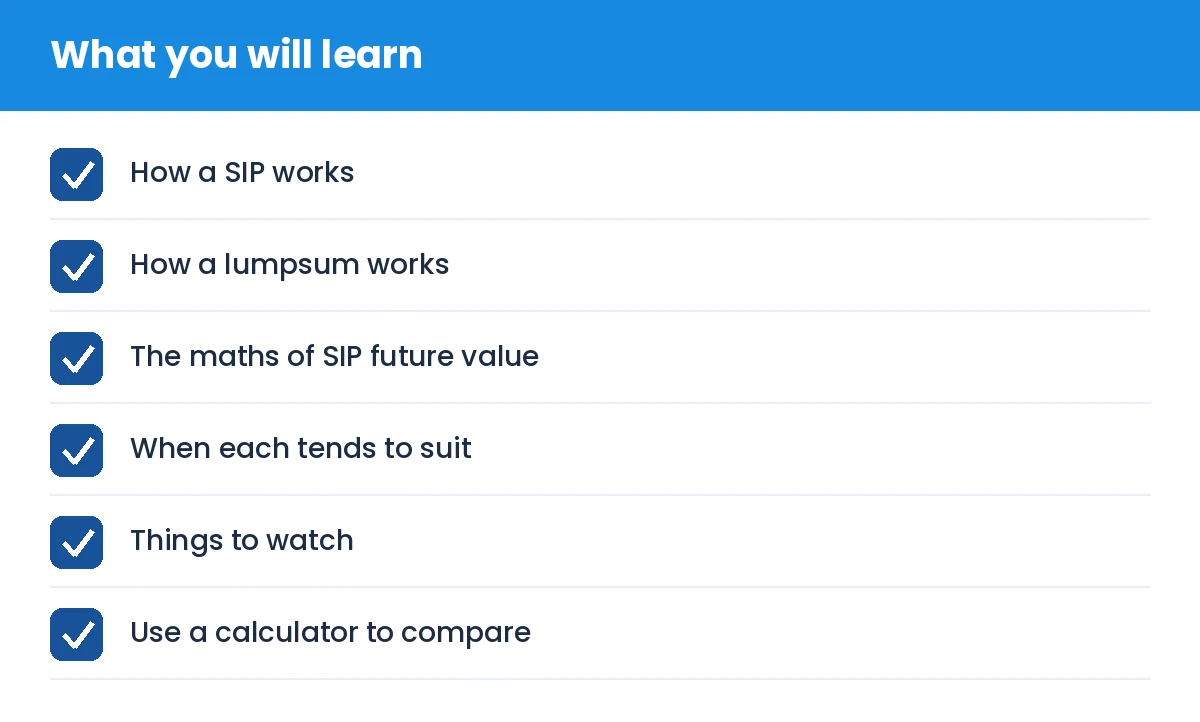
SIP vs Lumpsum: Which Is Better for Indian Investors?: what you will learn
This article is general information, not investment advice. Mutual fund investments are subject to market risk.
How a SIP works
You choose an amount, for example Rs 5,000, and a date. Each month that amount buys units at that day's price. When markets fall you get more units, when they rise you get fewer. Over years this averages your cost, which is sometimes called rupee-cost averaging.
How a lumpsum works
You invest the whole amount on one day. All of it starts compounding immediately, but your result depends heavily on the price on that day.
The maths of SIP future value
A SIP calculator uses the standard formula for monthly compounding on a series of payments. With an assumed return r per year, the monthly rate is r / 12, and each instalment grows for the months it stays invested. For example, Rs 5,000 per month for 10 years at an assumed 12 percent per year grows to roughly Rs 11.6 lakh, of which Rs 6 lakh is what you put in. The return is an assumption and real returns will differ.
When each tends to suit
SIP suits people who earn a monthly salary, want discipline, and do not want to time the market.
Lumpsum suits someone who has received a bonus, maturity amount or inheritance, and has a long horizon. Some people split it into a few instalments (a staggered entry) to reduce timing risk.
Things to watch
Expense ratio, since a high ratio eats into returns every year.
Taxes on gains, which depend on the fund type and the holding period. Check the current rules.
Your time horizon. Equity funds are generally meant for five years or more.
Emergency fund first. Do not invest money you may need within a year.
Use a calculator to compare
Try both options in our SIP and lumpsum calculators with the same assumed return and period. Change the return by two or three points up and down to see how sensitive the result is. If the numbers swing wildly, the plan depends too much on one assumption.
Bottom line
SIP reduces the stress of timing and builds a habit. Lumpsum puts money to work sooner. The right choice depends on how your income arrives and how long you can stay invested. For personal advice, speak to a SEBI-registered adviser.